


Classical Music Finds Strange Harmony at Makrokosmos
The annual concert series upends convention and, this time around, encourages audience participation.
WILLAMETTE WEEK | By Nathan Carson | June 23, 2026 5:40PM PDT
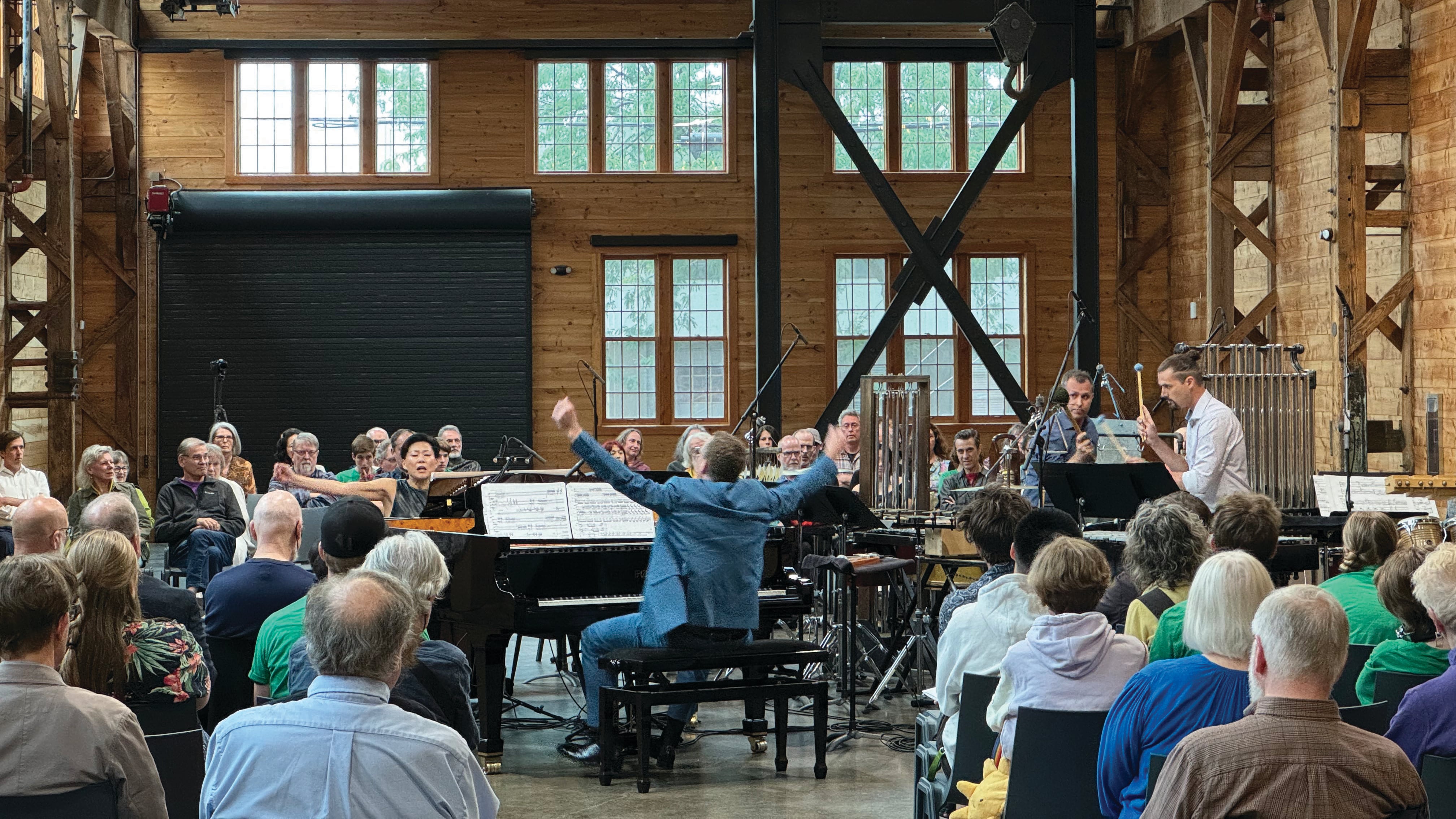
Makrokosmos 2024 (Courtesy of Makrokosmos Project)
Traditional symphony programs tend to open with a glimpse of a newer composition, something in the nine-minute range. Whether this whets listeners’ appetites or sends them running to the bar depends on their tastes. But to broad-minded music fans, this is often the most exciting part of the program. Those opening salvos are normally followed by a traveling musician performing a canonical work and some sort of rote, baroque finale.
“We want our event to be an entire evening of those nine-minute modern pieces,” Saar Ahuvia tells WW with a smile.
For a dozen years running, Ahuvia and his wife, fellow pianist Stephanie Ho, have graced Portland with an annual classical event called makrokosmos project that is anything but a traditional symphony program. The latest edition, which takes place inside BodyVox dance studio in Northwest, features many of the area’s best pianists and the Portland Percussion Group. Instead of a dusty canonical finale, it culminates with a rendition of Terry Riley’s groundbreaking In C—and they would appreciate it if you’d bring an instrument to play along.
The couple lives in New York City, but they summer in Portland—skipping out on the humidity and enjoying this city’s classical micro-culture. They met as graduate students at a jazz improv class and went on to international acclaim in the piano four hands field, particularly for their striking arrangement of Stravinsky’s Rite of Spring. The New York Times lauded their 2013 performance’s focus on rhythm, dynamics and “harmonic strangeness.”
Ho’s family still lives in the Portland area, and, thanks to a connection with the Old Town restaurant Mandarin House, helps provide refreshments for makrokosmos attendees. In the classical world, a long evening of music plus wine and snacks is quite a bargain for only $20. And if five hours of often demanding music sounds daunting, know that attendees are encouraged to come and go as they please.
This isn’t the stodgy Bach show you were herded to on a high school field trip, or the Easter Sunday matinee of Handel’s Messiah that you took Grandma to see. Expect folding chairs arranged in creative ways and generously filled plastic wine glasses. Audiences are still expected to be polite (it’s not a jazz club!), but this is the rare classical setting where you can let your hair down, enjoy yourself, nosh and mingle between sets.
Since the inaugural makrokosmos in 2015, Ho and Ahuvia have presented works by John Adams, Meredith Monk, Philip Glass, and a host of other luminaries of 20th and 21st century avant-garde classical music. The name comes from a series of George Crumb piano pieces titled Makrokosmos (a Greek word for “vast universe”) inspired by Béla Bartók’s original Mikrokosmos. The event has taken place in various spaces, including the offices of the Danish wind turbine company Vestas, the Portland Institute for Contemporary Art’s warehouse gallery, and the now-defunct World of Speed car museum in Wilsonville.
The 12th edition will kick off with a happy-hour performance of Trekking by living legend Meredith Monk. The second hour, dubbed “Latin Groove,” features more pianos and percussion-heavy pieces by composers from Italy, Cuba, Mexico and Miami.
The penultimate work is Patterns and Form by Argentine composer Alejandro Viñao, a 2024 commission recorded by the Portland Percussion Group and released under the same title in February 2026. Across its three movements, mallets dance over vibes and marimba. As Ho describes, “the rhythms shift in and out of phase.”
In contrast, Terry Riley’s landmark 1964 composition In C, the evening’s culminating piece, contains a steady pulse throughout. Heavy on melody, it was not initially written with such a pronounced rhythm. Riley’s minimalist contemporary Steve Reich suggested that he include one, particularly because the 53 sections of In C are all drafted on a single piece of sheet music, with a healthy amount of improvisation being encouraged, or even required. For the makrokosmos version, audience members are encouraged to bring their own instruments (in the key of C) to partake in the ecstatic cacophony.
While LaMonte Young made some of the earliest musical statements in the minimalist field, Terry Riley brought that form to the masses. His 1968 Columbia recording of In C inspired Pete Townsend, who nodded back with The Who’s “Baba O’Riley” three years later. Riley had been working with tape loops and, not so incidentally, peyote and mescaline. Classical music practices collided with the swinging ’60s.
The letter C theme in this latest makrokosmos show points to a theme of community. “We’ve reached critical mass!” Ho says. And Ahuvia ends our conversation with encouraging words that explain why Riley’s buoyant In C is the event’s 2026 centerpiece. “We live in a dark time right now,” he says, “with great uncertainty about the future. We would like this year’s festival to bring people together as a community and be fun, joyous and uplifting.”
HEAR: Makrokosmos project 12 at BodyVox, 1201 NW 17th Ave., 503-229-0627, makrokosmosproject.org. 5 pm Friday, June 26. $15–$20.